
By Ali Harb
Abdul El-Sayed won the US Senate primary in Michigan in August by 15,697 votes.
The Egyptian American physician’s margin of victory in Dearborn, Dearborn Heights and Hamtramck – Wayne County cities with large Arab and Muslim communities – was 18,367 votes.
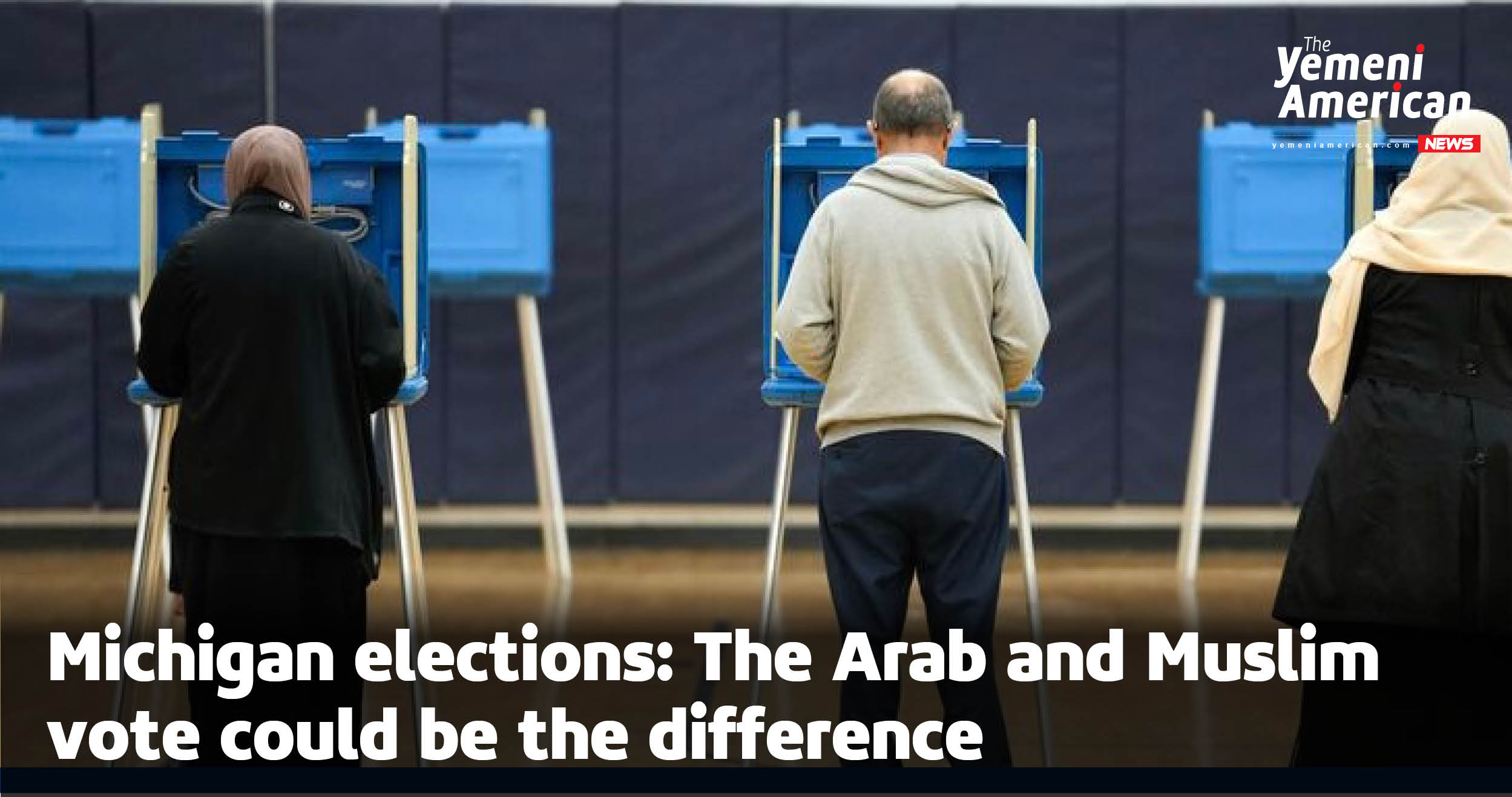
It is not hyperbolic to say that Arab and Muslim voters can swing the result in state-wide elections in Michigan. It’s a fact backed by the numbers.
According to research by the Arab American Institute, which adjusts Census data to correct for undercounting, Michigan’s Arab population is nearly 400,000 people.
That’s around 4 percent of the population in Michigan.
While not all Arabs are Muslims and not all Muslims are Arab, the two communities overlap demographically, socioeconomically and most importantly politically in Michigan – making them a formidable voting bloc.
So Arab and Muslim Americans combined likely represent more than 4 percent of Michigan.
Close elections
The size of these communities can translate into immense electoral power.
For comparison, Cuban voters in Florida are largely seen as kingmakers in the state that has been turning more Republicans in recent years.
However, like Arabs and Muslims in Michigan, Cubans are a minority in Florida albeit a slightly larger one – around 7 percent of the state’s population.
In close elections, Arabs and Muslims do not need to be the majority of voters to be influential. They just need to vote in numbers large enough to swing the results by a couple of percentage points.
Many recent statewide elections in Michigan have been won by razor-thin margins.
In 2016, President Donald Trump won Michigan by 10,704 votes – 0.23 percent. He won the state again in 2024 by 1.42 percent of the votes in 2024. That same year, Democratic Senator Elissa Slotkin defeated former Republican Congressman Mike Rogers by 0.34 percent – 19,000 votes.
One of the reasons Slotkin won while then-Vice President Kamala Harris lost at the top of the ticket is that the senator out-performed the Democratic presidential nominee with Arab voters.
Trump won Dearborn in 2024 by more than 2,600 votes, but Rogers – his fellow Republican – lost to Slotkin in the city.
Trump reclaimed Michigan after losing it in 2020 partly by actively courting Arab and Muslim communities.
The Republican president visited Dearborn during the campaign and relied on Arab and Muslim surrogates to reinforce his promises of bringing peace to the Middle East.
Facing decisive races for governor and the US Senate, Republicans seem to have forgotten that lesson. They are not only ignoring Arab and Muslim communities; they are actively alienating them.
Republican Congressman John James, who is running for governor, has pledged to designate the Council on American-Islamic Relations (CAIR) – the largest Muslim civil rights group in the country – as a “terrorist” organization.
Rogers v El-Sayed
Likewise, Rogers has not learned from his costly underperformance in the Arab community in 2016 as he takes on El-Sayed.
Instead, he has failed to speak out as his allies lean on blatant Islamophobia to demonize El-Sayed.
For example, the National Republican Senatorial Committee (NRSC) has attacked El-Sayed repeatedly over his Arabic name.
Rogers has also pledged to “unconditionally” support Israel in the Senate.
And while continuing to promise to send Michigan’s taxpayers money to a foreign nation, he has accused El-Sayed of being more “worried about Gaza than your gas prices.”
Expressing support for Israel and using Gaza as a political punching bag will not do Republicans any favours with the electorally important Arab community, which has been affected first-hand by Israel’s wars in the region.
Trump’s policies, including the war on Iran and crackdown on Palestinian rights activism, further set the GOP back in Michigan.
Recent elections have shown that Arab and Muslim voters do not have a deeply-rooted party loyalty.
Instead, they back candidates that speak to their issues, and they withhold their votes against politicians that go against their priorities.
That makes them a swing constituency that can help decide the future of the state and the country.