

By/ Adel AlAdlani *
The rhetoric that reduces nations to slogans and scapegoats has a way of collapsing under the weight of evidence. When Donald Trump recently repeated his characterization of certain nations as unworthy, broken, and unfit as sources of immigrants, he was not describing peoples he knew, but caricatures he needed. Such language betrays an education in slogans rather than in history; it is the speech of a man who has never learned that contempt is the cheapest substitute for comprehension. The Yemeni American story, written in ledger books, factory floors, and the quiet dignity of constitutional belonging, tells a different truth.
The most statistically concrete rebuttal begins at the corner store. According to the U.S. Embassy in Yemen, Americans of Yemeni descent own up to 50 percent of New York City’s grocery stores, including those in Brooklyn, with estimates placing the number of Yemeni-owned bodegas between 4,000 and 6,000 out of roughly 10,000 citywide. These are not marginal enterprises. They are economic anchors in neighborhoods that depend on them for daily necessities, employment, and the informal social contract that makes urban life bearable. The Yemeni American Merchants Association has organized these entrepreneurs into a force capable of collective action, including a citywide bodega shutdown in 2017 to protest the Muslim Ban. When Trump consigns Yemen to the category of nations he deems beneath contempt, he is insulting the lineage of the very people who stock the shelves of his own city.
But the Yemeni American contribution to American industry predates the bodega by nearly a century. In the early 1900s, Henry Ford actively recruited Yemeni workers to labor in his factories, sending recruiters abroad and building a community in Michigan that persists today. Ford “actually sent people to recruit the Arab and Arab American community to work in the auto industry,” opening doors in Yemen and Lebanon and telling workers they could earn a great wage in America. Those workers “dove in and became a part of American society and contributed massively to the economic force in this region.” When Trump’s rhetoric reduces Yemen to a source of undesirables, he erases the fact that American industry once knocked on Yemen’s door and asked its people to build the country’s most iconic machines.
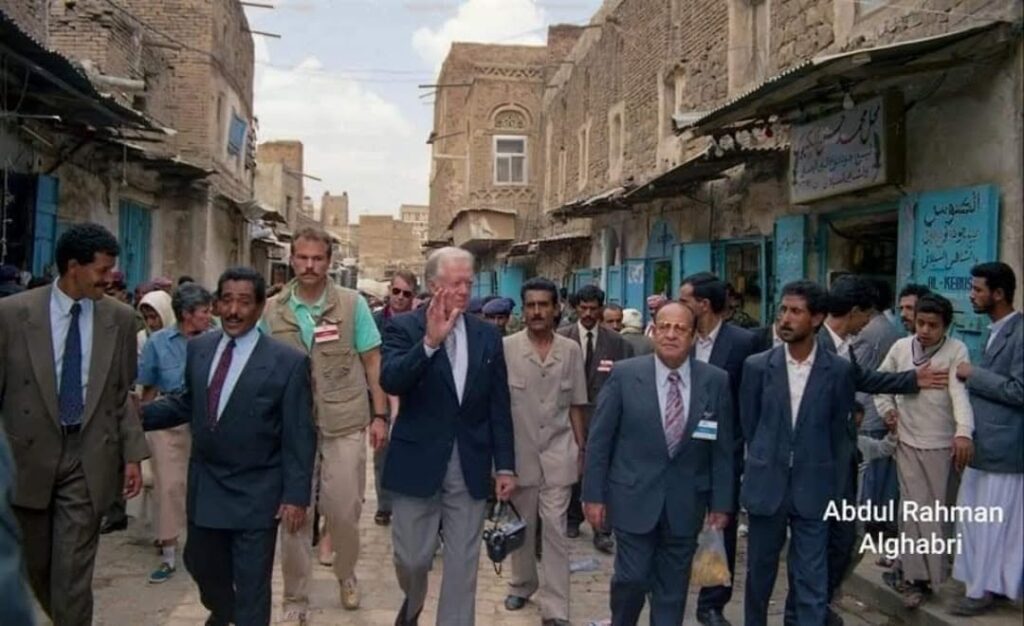
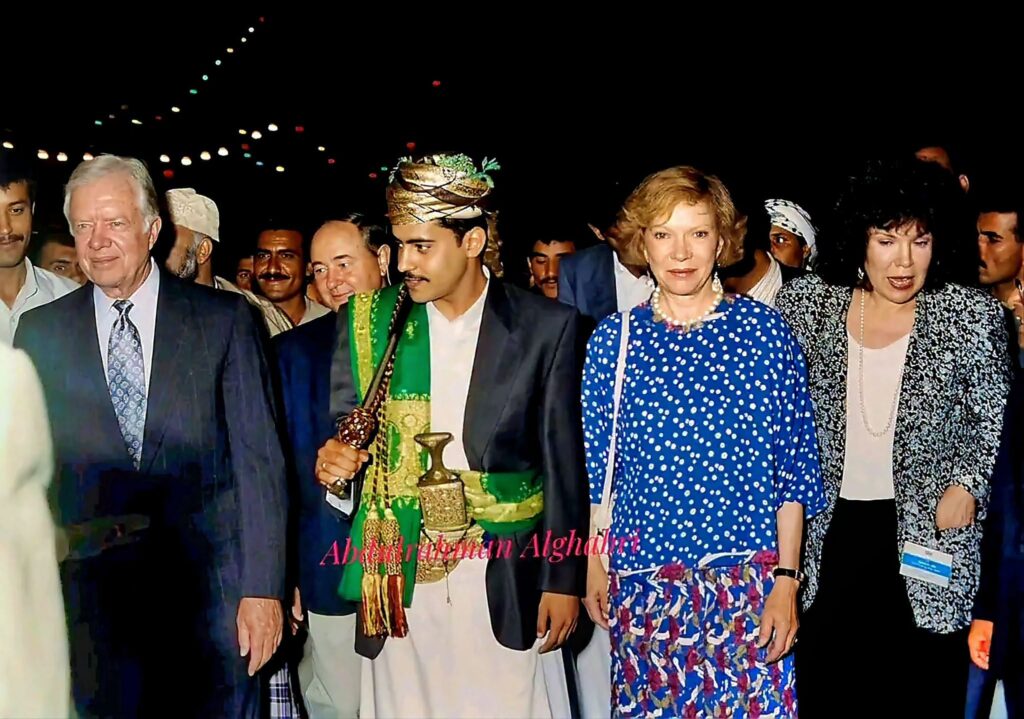
This ignorance of history is not merely rude; it is a category error. Trump’s dismissal is the gesture of a man who, handed a key to a library, complains that it doesn’t open a landfill. He sees only what he cannot read. Yemen is home to Shibam, the “Manhattan of the desert,” a UNESCO World Heritage site of mud-brick towers that have stood for centuries. It is the land of the Queen of Sheba, of the ancient incense trade, of an Old City in Sana’a continuously inhabited for more than two millennia. When George H.W. Bush visited Sana’a in 1986 as Vice President, he later recalled “the rich history of the Old City” and “the warm welcome that we received from the people of Yemen.” Speaking at the White House in 1990, Bush noted the presence of “over 40,000 immigrants of Yemeni heritage who have settled here in the United States” and expressed his hope that relations between the two nations would “continue to prosper and grow.” Jimmy Carter, captivated by Shibam in 1993, remarked through his Yemeni photographer companion that “it is one of the wonders of the world that we are driving inside a great museum,” and told Yemeni leaders: “You have a country without equal.” These were not diplomatic platitudes. They were the impressions of men who had seen the country and recognized its inheritance, an inheritance Trump’s vocabulary cannot accommodate.
The constitutional dimension of this argument is not decorative. The Equal Protection Clause of the Fourteenth Amendment and the Due Process Clause of the Fifth Amendment guarantee that no person shall be denied equal protection of the laws on the basis of national origin. When a political leader singles out immigrants from particular nations for degradation, he attacks the principle that belonging in America is determined by contribution and character, not by the accident of birth or the prejudice of the powerful.
Yemeni Americans have served in the U.S. military, built businesses, and entered the professions. Dr. Aisha Jumaan, a Yemeni American public health epidemiologist, spent over a decade at the U.S. Centers for Disease Control and Prevention working on vaccine-preventable diseases before directing the HPV vaccine project at PATH, and later founded the Yemen Relief and Reconstruction Foundation to address the humanitarian crisis in her native country. Ammar Al-Ali, a Yemeni American inventor and engineer based in California, holds multiple patents spanning medical diagnostic devices, biosensors, and remote monitoring systems, tangible contributions to American technological innovation. These are not the biographies of a people Trump would dismiss. They are the biographies of a people who have made America more capable, more prosperous, and more humane.
The grocery stores owners of Brooklyn, the Ford workers of Dearborn, and the public health researchers of the CDC share a common inheritance, which is a tradition of work that does not wait for permission. They built their legacy shelf by shelf, assembly line by assembly line, patent by patent, without asking whether a president approved of their origins. Trump’s dismissal is not an argument. It is a confession, of a man who mistook a library for a landfill because he never learned to read. The Constitution does not require that he read. But it does require that his ignorance not become law. Yemeni Americans have already written their rebuttal. No slogan can stock it away.
* Adel AlAdlani has a PhD in Public Administration from Western Michigan University