

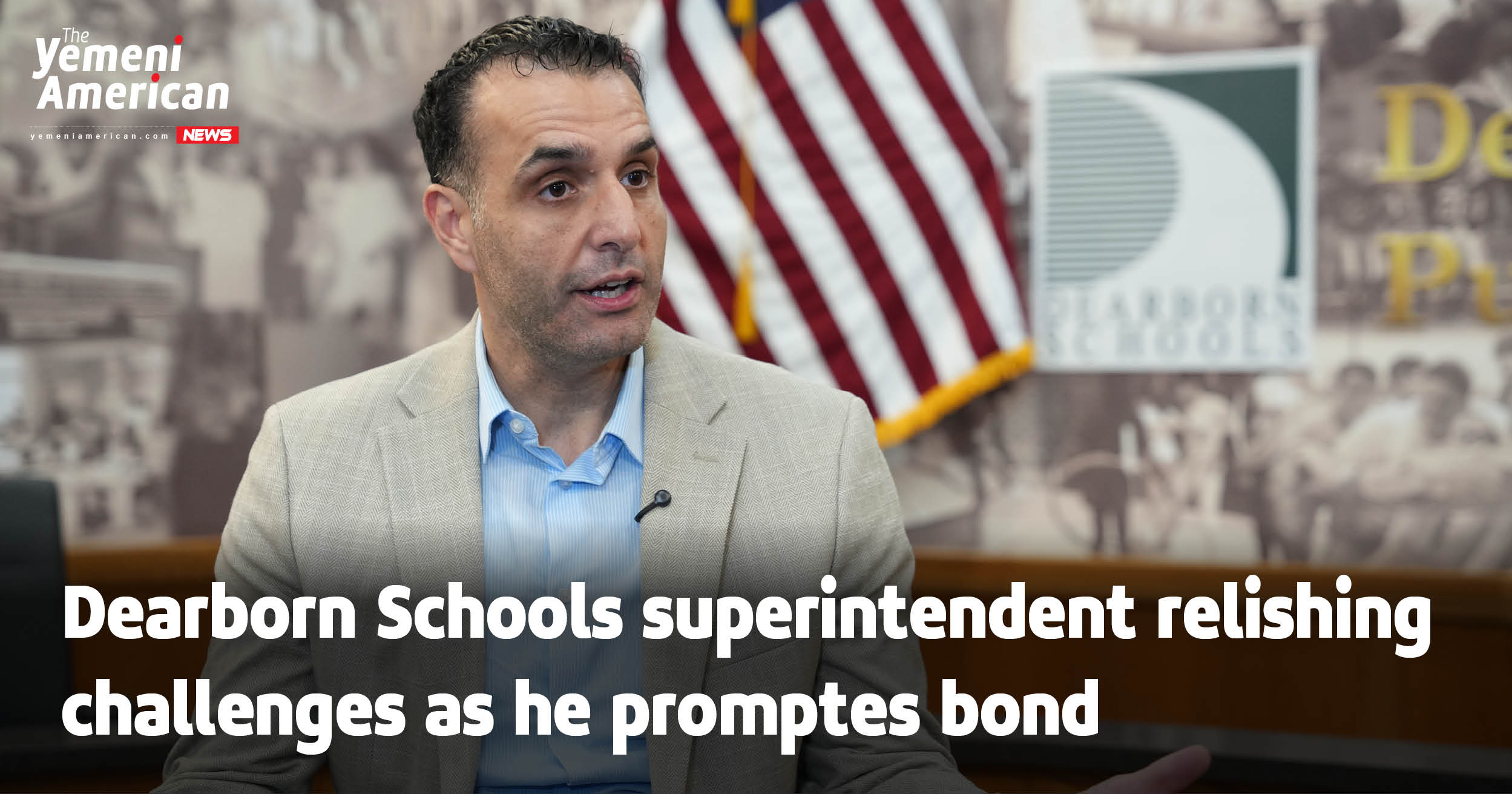
Leading Dearborn Public Schools, a district serving a growing, diverse and dynamic population, is not easy. But superintendent Mike Esseily is relishing the challenge with a sense of responsibility to the community that is his own.
Additionally to his day-to-day duties, Esseily is facing an early challenge that could define the future of the district: promoting a bond to overhaul the physical infrastructure of the schools.
Voters will have to approve the proposal on November 3, which would raise $1.5 billion and kick off 20 years of construction.
Esseily, who started his tenure in July, is embracing the mission of pushing to pass the bond – because it is needed for the students and the community as a whole, he says.
The funds would be used to modernize decrepit school buildings throughout the district and build new ones.
“While I understand the challenge of being a new superintendent and also providing all this information on the bond, I can tell you that I wouldn’t rather have it any other way,” Esseily said. “This bond is a necessity right now.”
‘Community’s bond’
He stressed that the proposal is not just a priority for school officials but an issue that should matter for all residents in the district, which covers Dearborn and parts of Dearborn Heights.
“It’s not the seven board members’ bond. This is the community’s bond,” the superintendent told The Yemeni American News.
“When you have strong schools, you have a strong community. When you have strong schools, you have a safe community. When you have strong schools, you have a bright future. And that’s what this bond means to me. It’s a way of giving back to the Dearborn community.”
The funds raised by the bond will be offset by property tax reductions from the schools and the city in Dearborn, so it will change the tax rate.
In the Dearborn Heights neighborhoods served by the Dearborn district, property taxes will increase by a modest amount of 0.96 mills – that’s less than $100 a year per $100,000 in assessed home value.
Esseily addressed why the district is looking to raise funds via a bond instead of applying for infrastructure grants. The answer is that the schools’ needs are just too great for the available funding.
“I can tell the community that we will apply for grants whenever possible. We’ll apply for infrastructure grants. However, unfortunately, they’re just not there,” he said.
“I was doing some research, and I found out that the largest infrastructure grant ever given to a school district in Michigan was $19 million. Unfortunately, when you’re talking about 37 schools and so many needs, 19 million dollars won’t be much.”
‘Huge responsibility’
Esseily was selected by the school board earlier this year to succeed interim superintendent Lamis Srour, who in turn replaced Glenn Maleyko after he took the job of State Superintendent of Public Instruction.
The new superintendent knows the district like few – if any – others, not just as its current leader, but as an administrator, educator, assistant principal and a student, going back to when he attended McDonald Elementary in pre-school.
With the strong bond he has to the schools, he says he knew that serving as superintendent was not going to be an easy journey.
“Although it’s a huge responsibility, it is one that I guarantee I’ll never take lightly,” Esseily said. “I come to work every day with great passion and commitment to this community.”
He told The Yemeni American News that one of his main goals is to increase reading proficiency in the district.
“We’ve refined the multi-tier system of supports,” Esseily said.
“In addition to that, right now we’re currently working with the organization who does letters training, and letters training is the science of reading training that also provides training to our teachers as to how the brain processes [information], learns and works.”
Esseily added that he also aims to ensure that students stay in the Dearborn Public Schools system and take pride in it.
“That is why we’re working on different pathways for them to ensure that it’s about their interest level and their skill set,” he said.
“So when they leave us, they can either be career or college ready.”