
By Ali Harb
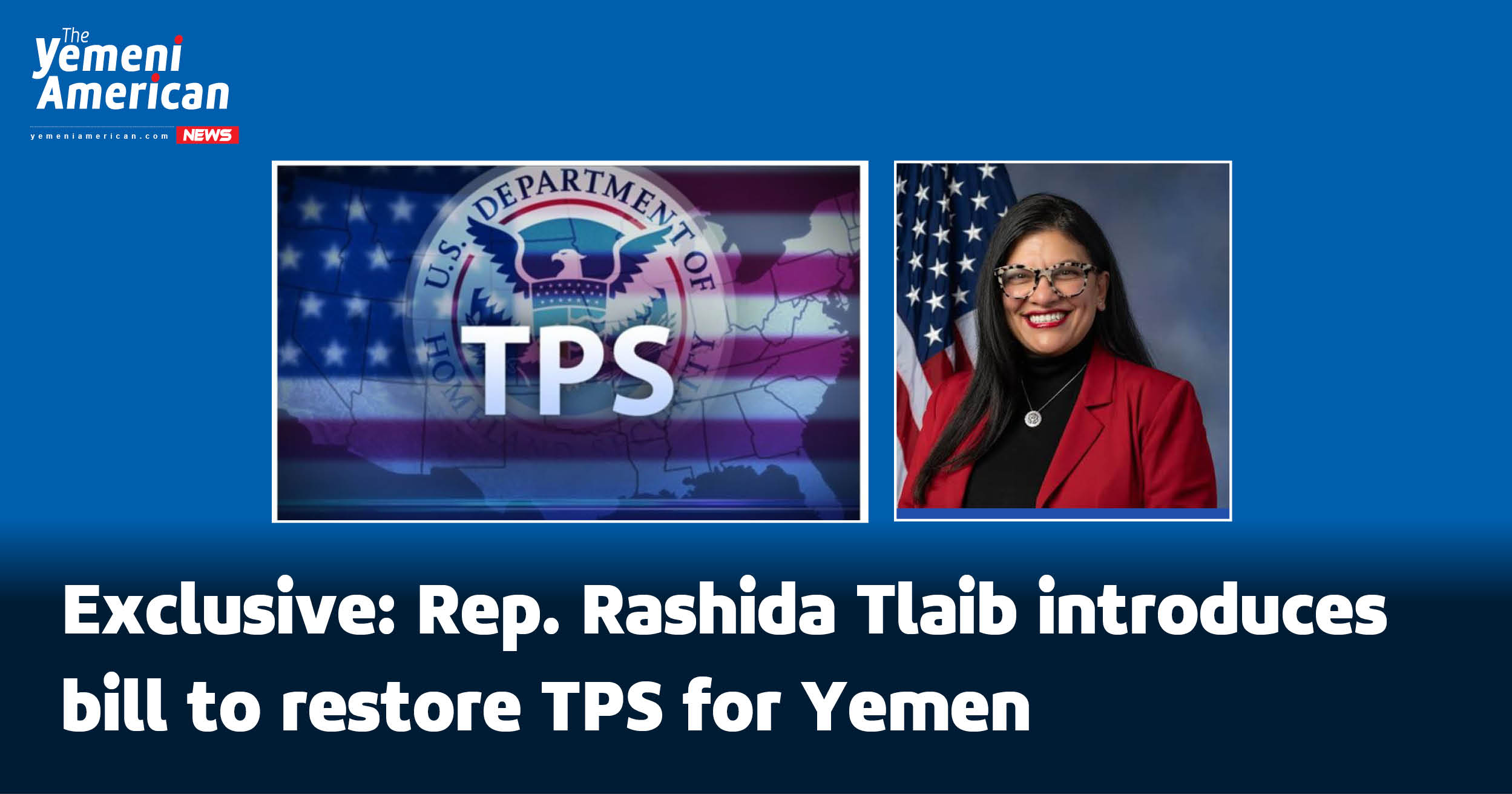
Congresswoman Rashida Tlaib has introduced a bill to designate Yemen for temporary protected status (TPS), which would shield Yemenis in the United States from deportation due to the deteriorating security situation in their home country.
The measure, first shared with The Yemeni American News on Monday, comes after President Donald Trump announced revoking TPS for Yemenis in February as part of his immigration crackdown – a move that civil rights advocates decried as arbitrary and cruel.
The status was officially terminated in July after a court battle.
Tlaib’s bill is co-sponsored by 14 of her fellow Democrats, including Ilhan Omar, Andre Carson and outgoing Detroit-based Congressman Shri Thanedar. It would compel the Department of Homeland Security to grant TPS to Yemeni nationals for three years.
“The Trump administration is threatening our Yemeni neighbors, and I will not stand for it,” Tlaib told Yemeni American News in a statement.
“DHS unjustly terminated temporary protected status for Yemen without care for the ongoing humanitarian catastrophe and escalating armed conflict facing the country.”
Tlaib underscored the US military involvement in Yemen and paid a nod to the Yemeni constituents in her district, which covers Dearborn, Dearborn Heights and parts of Detroit.
“The Trump administration was bombing civilians in Yemen as recently as last year and is currently trying to give the Saudi monarchy billions of dollars in bombs and jets to continue the devastation,” Tlaib said.
“The State Department explicitly warns against any travel to Yemen, and yet, this president wants to send our neighbors back as part of his racist mass deportation agenda. I am proud to represent one of the most Yemeni districts in the country. These are our family members, coworkers, friends, and neighbors. They belong here, and I will not turn my back on them.”
The proposal is unlikely to pass in the Republican-controlled House of Representatives.
But Tlaib’s bill could renew the debate about the plight of Yemenis stuck in limbo and set the stage for a renewed push for a TPS designation in the new Congress, which comes into office in January after the midterm elections next month.
The congresswoman is from Detroit, but she has deep family ties to the Southend neighborhood in Dearborn – home to a large Yemeni community.
The State Department has Yemen under the highest level of travel advisory – “Do not travel.”
“Do not travel in Yemen due to risk of terrorism, unrest, crime, health risks, kidnapping and landmines,” the advisory says.
The logic behind TPS is simple: if you are in the US on a temporary basis – for example as a student or visitor – and the conditions in your home country are too dangerous, you may remain in America and work legally on a temporary basis.
Federal guidelines say that a country may be designated for TPS in the case of conditions “that temporarily prevent the country’s nationals from returning safely”.
Over the past year, the Trump administration has terminated TPS for several countries, including for some plagued by violence and humanitarian crises, such as Haiti.
The revocations were challenged in the judicial system, but the Supreme Court issued a ruling in June restricting judges’ ability to weigh in on the designations.
Since Trump’s return to the White House, DHS has cancelled or failed to renew TPS for 13 countries, leaving a handful of nations on the list and all but dismantling the programme.
TPS for Lebanon, which is suffering from a deep economic crisis and an expanding Israeli occupation in the south of the country, is set to expire next month.
Trump ended immigration protections for Yemenis despite receiving support from some prominent Yemeni American leaders during the 2024 elections.